Introducing the Koenigsegg CCGT1: A Track-Optimized Salute to Koenigsegg’s Iconic GT1 Racer
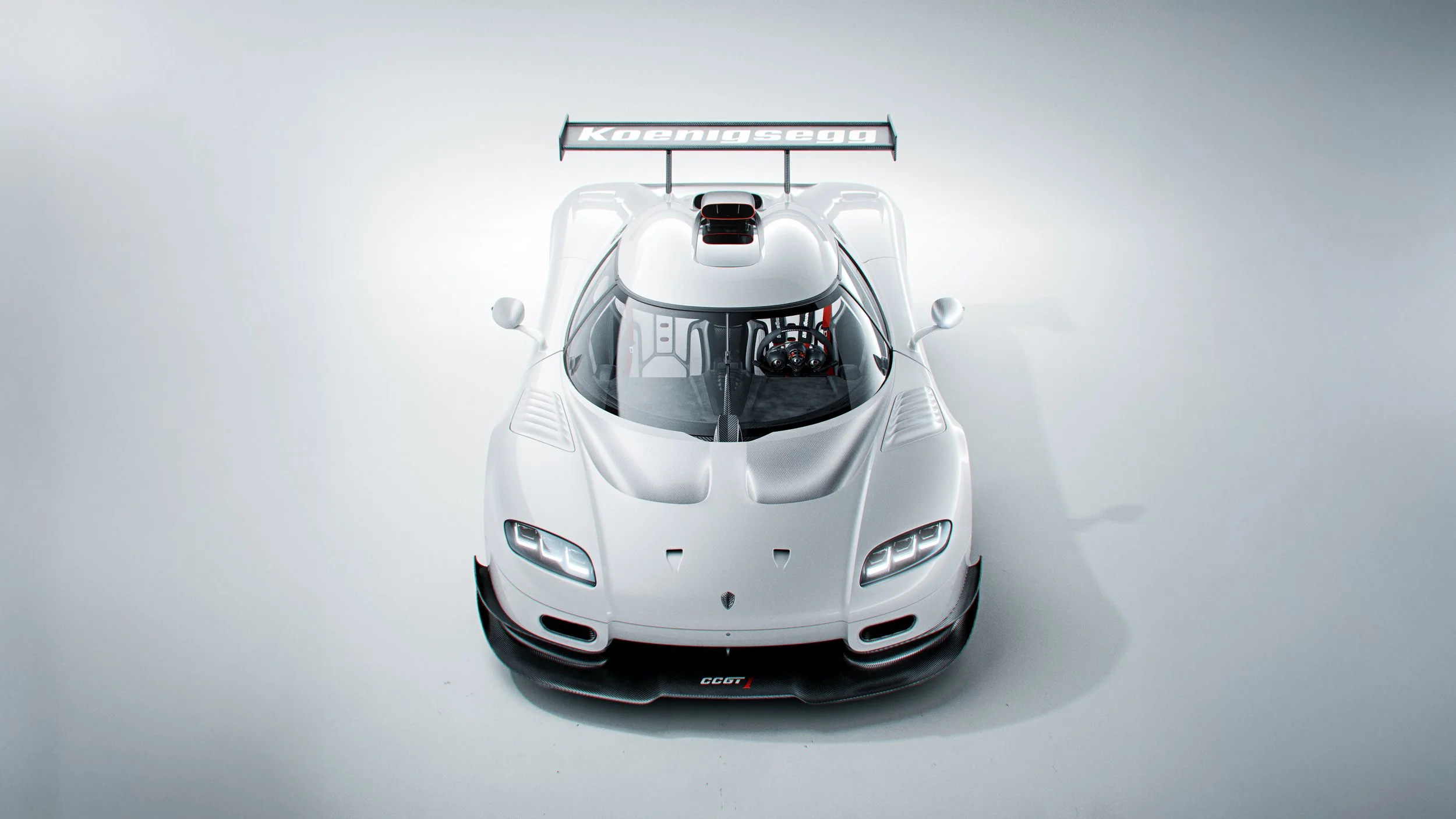
Koenigsegg has unveiled the CCGT1, a new limited-run Megacar built to honor the CCGT, the company's GT1 endurance racer from the mid-2000s. Where the CC850 pays tribute to the CC8S, the car that started it all for Koenigsegg, the CCGT1 pays tribute to a car that almost never got the chance to prove itself.
The story of the original CCGT is one of unfortunate timing. Christian von Koenigsegg had racing in mind from the very start of his sportscar career. While designing the first CC prototype, he studied the Le Mans GT1 rulebook closely enough to scale the car's width and frontal area to fit GT1 regulations without needing to change anything later for a racing version. Those same dimensions carried through the CC8S and CCR, so when Koenigsegg eventually built an actual GT1 racer, it fit the mold that had been set years earlier. That car became the CCGT.
Working with longtime Koenigsegg engineer and fabricator Dag Bölenius, Christian built the CCGT to come in well under the GT1 class weight limit of 1,100kg, weighing around 1,000kg instead. That left plenty of room to place ballast wherever it was needed for ideal balance. Power came from a naturally aspirated 5.0 litre Koenigsegg V8, tuned to the class-mandated maximum of 600hp and sent to the rear wheels through a magnesium sequential gearbox. The aero package generated over 600kg of downforce. Renowned test driver Loris Bicocchi handled setup duties, and from the very first laps, the CCGT showed real pace.
Then the FIA rewrote the GT1 rulebook, just two months after Koenigsegg began shakedown testing, limiting the class to higher volume production cars. Between the low production numbers of every GT1 entrant and the rising cost of competing, manufacturers dropped out one by one until the series folded entirely. The CCGT program was shelved before it ever turned a competitive lap. Only one was ever built. It spent the next fifteen years with its first owner before surfacing for sale at Goodwood FoS in 2024.
Today, the original CCGT belongs to a dedicated US-based custodian and has been fully refurbished by the Koenigsegg Legend Division. It is finally set to race in the GT1 historic class, nearly two decades after it was built to do exactly that.
A Modern Salute
The CCGT1 is Koenigsegg's way of marking that moment. Built on the award-winning CC850, itself a tribute to the CC8S, the CCGT1 carries the CCGT's name and spirit forward as a fully homologated, road-legal Megacar. On its own it promises an exceptional road driving experience, and with Koenigsegg's first-ever factory-authorized optional track package fitted, the company says it will deliver the fastest, most exhilarating track experience of any Koenigsegg yet.
"This is something truly special - our first creation that's designed deliberately as a track-optimized circuit scalpel as well as an extraordinary daily driver. It has been so rewarding seeing the original CCGT come back to life over the last few years. This seems like an appropriate way to celebrate. I'm very excited to drive and explore its full capabilities, and I can't wait for the wider Koenigsegg family to do the same. To also showcase our newly developed Ghost Fibre for the first time is truly exciting and builds on the history of the Trevita project, that was launched in the same era as the CCGT." - Christian von Koenigsegg
Nearly every body panel has been redesigned from the CC850's, with only the doors and removable roof carried over. The most obvious change is the CCGT1's enormous rear wing, a direct nod to the original CCGT's fixed unit but reimagined as an active piece with 30 degrees of adjustment. It shifts automatically between a low-drag setting on the straights, an air-brake mode under hard braking, and a high-downforce setting through corners.
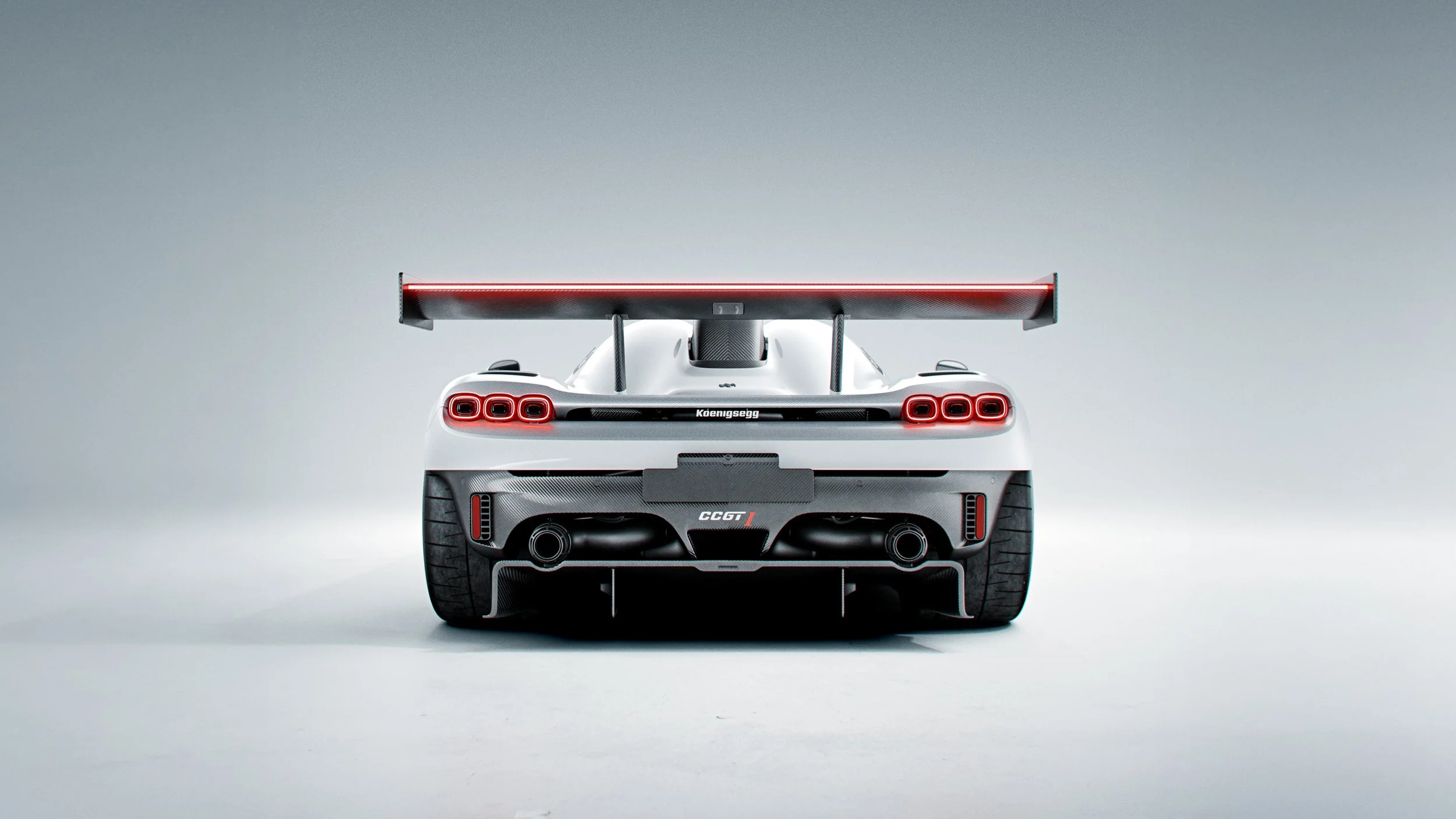
CFD engineer Andreas Tjernberg Persson led the aero program and was quick to point out that the wing is only part of the story.
"Everything in aerodynamics is about balance," says Persson. "The rear wing works beautifully and is both a visual and functional nod to the original CCGT, but it would be pointless on its own. We had to address the balance at the front of the car, too."
That balance comes from a large front splitter and active underbody flaps working against the rear wing's load, along with a sculpted underfloor with strakes generating low-pressure vortices and a bespoke rear diffuser. According to Persson, the floor does most of the heavy lifting.
"The rear wing is big, yes, but it actually has a tiny surface area compared with the floor. The floor is much bigger and therefore much more efficient at controlling and directing airflow."
The result is 800kg of downforce at 250km/h, which places the CCGT1 between the Jesko Attack and Sadair's Spear for peak downforce, while giving the driver accessible grip at comparatively lower speeds.
"The Jesko Attack was once our highest-downforce car," says Persson. "Then came Sadair's Spear, which has 30% more downforce than the Attack. The CCGT1 sits between the two for peak downforce, but it has been specifically designed to provide accessible downforce at comparatively lower speeds, giving the driver an outstanding driving experience. That's what good aero design can do."
Power and a New Way to Shift
The CCGT1 uses Koenigsegg's twin-turbo V8, producing 1,280hp on standard pump fuel and 1,600hp on E85 biofuel, with the company's in-house engine management system allowing any blend of the two. A new roof scoop feeds an enlarged oil cooler and a dedicated cooling system for the dampers, aimed at keeping performance consistent through long track sessions.
For the transmission, the CCGT1 keeps Koenigsegg's nine-speed Light Speed Transmission but pairs it with an entirely new shifting interface: Koenigsegg Sequential Shift (KSS), standard on every car. KSS uses a clutch pedal for take-off and ignition-cut, clutchless shifts from there, just like the original CCGT. It's mounted close to the steering wheel and only needs a short, fast movement to change gears, quicker than an equivalent H-pattern manual. A four-position dial labeled ASMR sits ahead of the shifter and controls Auto, Sequential, Manual, and Reverse modes.
Buyers who want the traditional Koenigsegg manual experience can instead option the CC850's award-winning Engage Shift System (ESS), a gated six-speed shifter with a clutch pedal. In Manual mode, ESS uses six of the LST's nine gears, while D mode still allows nine-speed automatic driving for everyday use.
"The CCGT1 is a creation with two clear identities. On the road, it's a sublime Megacar that's both comfortable and incredibly capable. But its origins are rooted in endurance racing, and that's where the CCGT1 reveals its full character as a true celebration of the original CCGT - with or without its roof!" - Christian von Koenigsegg
Cockpit
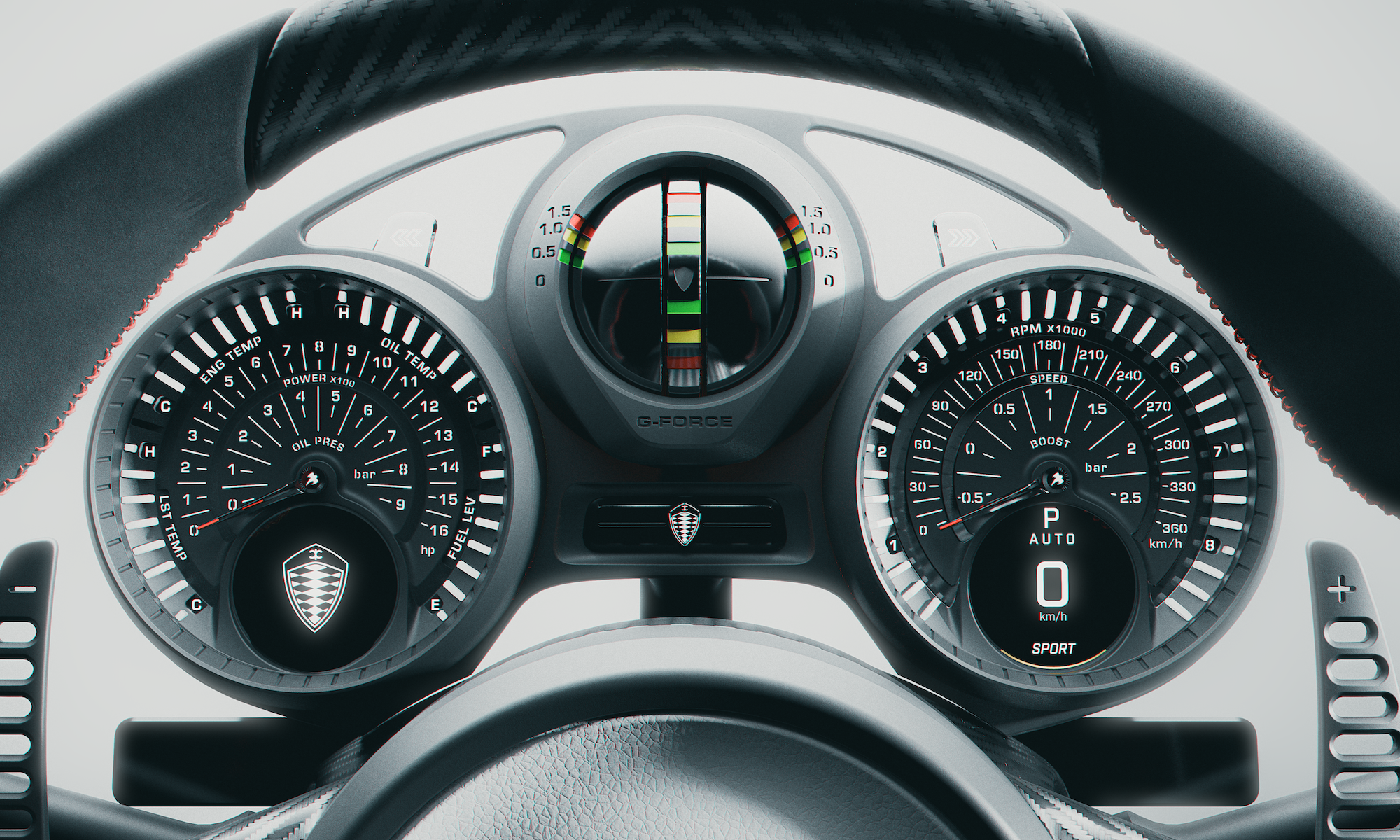
Inside, the CCGT1 makes its intentions clear right away, with a covered ignition switch, a toggle to prime the fuel pumps, and a red starter button for the V8. The third-generation Chronocluster keeps everything in view, with Koenigsegg's analogue G-meter, powered entirely by G-force with no electrical connection, sitting at its center. The sequential shifter sits just inches from the steering wheel.
Standard seats are ultra-light carbon fibre with a six-point harness for the driver. The optional track package adds racing seats and six-point harnesses for both occupants, along with a race-grade fire-suppression system. Koenigsegg's touchscreen infotainment system rounds out an interior built for both a Sunday drive and a full day at the track.
Koenigsegg's First-Ever Track Package
For the first time, Koenigsegg is offering a factory-designed track package, available through any Koenigsegg Certified Dealer and able to be installed or removed as needed. It includes a full carbon roll cage, HANS-compatible racing seats, a fire-suppression system, a race exhaust, air jacks, track-tuned suspension and brakes, a second set of wheels with track-optimized tires, enhanced aerodynamics, and an invitation to exclusive CCGT1 track days with full factory support.
With the package fitted, Koenigsegg says the CCGT1 becomes its fastest-ever circuit performer, with the race exhaust and track tire combination promising the quickest lap times the brand has produced. The enhanced cooling systems mean drivers should be able to lap harder for longer, and the integrated air jacks and telemetry system are meant to deliver something closer to a real race weekend than a casual track day.
The Return of a Legend
The CCGT1 also brings back a piece of Koenigsegg history: white carbon fibre. Back in 2009, the Trevita project introduced an industry-first white fibre finish, but the process took years to develop and proved so difficult to execute that Koenigsegg eventually stopped production. Owners never stopped asking for it to come back.
Now it has, in a new form called Ghost Fibre. It's an entirely new development rather than a revival of the old process, combining the shimmering look of the original with new functional benefits. Beyond the appearance, the fibres add ballistic protective characteristics and a sound-deadening effect to the bodywork, while still keeping the panels lighter than a traditional carbon fibre lay-up. The finished look has been described as a crystal-white aramid/carbon matrix, finished with Koenigsegg's signature weave.
Final Word
"The CCGT1 has two clear identities. On the road, it's a sublime tourer that is both comfortable and incredibly capable. But its origins are rooted in endurance racing, and that's where the CCGT1 reveals its full character as a true celebration of the original CCGT - with the roof panel on or off!" - Christian von Koenigsegg
"The CCGT1 offers something compelling to the weekend racer who also wants a daily driver with genuine extended capability on track. That's what our optional track package allows. Fit it for race day through your local Koenigsegg dealer, and the character changes completely - from an exceptional weekend tourer with respectable track credentials into a true circuit weapon."
The CCGT1 is limited to just 70 units, all of which were allocated before the car's public debut.